3.7 고대 켈트식 점술법
3.7 An Ancient Celtic Method of Divination
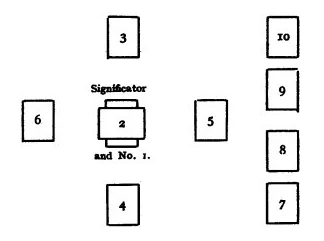
§7 고대 켈트식 점술법 이 점술법은 명확한 질문에 대한 답을 얻기에 가장 알맞다. 점술가는 먼저 질문의 대상인 사람이나 사물을 나타낼 카드를 고른다. 이 카드를 대표 카드(Significator)라고 한다. 자기 자신과 관련된 일을 알아보려 한다면, 자신의 외모에 해당하는 카드를 고른다.
질문의 대상이 마흔 살 이상인 남자라면 나이트를 대표 카드로 골라야 한다. 그 나이 미만인 남자라면 킹을 고르고, 마흔 살이 넘은 여자라면 퀸을, 그보다 어린 여자라면 페이지를 고른다. 완드의 네 궁정 카드는 노란색이나 적갈색 머리카락, 흰 피부, 푸른 눈을 가진 매우 밝은 외모의 사람을 나타낸다. 컵의 궁정 카드는 연한 갈색 또는 칙칙한 금발과 회색이나 푸른 눈을 가진 사람을 뜻한다. 소드의 카드는 헤이즐색이나 회색 눈, 짙은 갈색 머리, 칙칙한 피부색을 지닌 사람을 나타낸다. 마지막으로 펜타클의 궁정 카드는 매우 짙은 갈색 또는 검은 머리, 짙은 눈, 누르스름하거나 거무스름한 피부색을 지닌 사람에게 배정된다.
다만 다음과 같은 유보를 두어야 하며, 그래야 이 배정을 지나치게 관습적인 것으로 받아들이지 않게 된다. 때로는 그 사람의 알려진 기질을 기준으로 삼을 수 있다. 외모가 유난히 어두운 사람이라도 매우 활력이 넘칠 수 있으며, 그 경우에는 펜타클보다 소드 카드로 나타내는 편이 낫다. 반대로 외모가 아주 밝은 사람이라도 게으르고 무기력하다면 완드보다 컵에 배정해야 한다. 점술을 위해 질문의 대상인 사물 자체를 대표 카드로 삼는 편이 더 편리하다면, 그 사물에 해당하는 뜻을 가진 메이저 트럼프나 숫자 카드를 골라야 한다.
질문이 ‘소송이 필요할까?’라고 가정해 보자. 이 경우에는 11번 메이저 트럼프, 즉 정의를 대표 카드로 고른다. 이 카드는 법률상의 일과 관련된다. 그러나 질문이 ‘내 소송에서 성공할까?’라면 궁정 카드 중 하나를 대표 카드로 골라야 한다. 그 뒤 소송 과정 자체의 경과와 관계된 각 당사자에게 돌아갈 결과를 알아보기 위해 연속해서 점을 칠 수 있다.
대표 카드를 골랐으면 앞면이 위로 향하게 탁자에 놓는다. 그런 다음 나머지 카드 묶음을 카드 앞면이 아래로 향하게 두고, 섞은 뒤 나누어 다시 합치기를 세 번 되풀이한다. 카드 묶음의 맨 위, 곧 첫 번째 카드를 뒤집어 대표 카드 위에 덮고 이렇게 말한다. ‘이 카드가 그를 덮는다.’ 이 카드는 질문의 사람이나 사물에 전반적으로 영향을 미치는 힘, 곧 다른 흐름들이 작용하는 분위기를 보여 준다.
두 번째 카드를 뒤집어 첫 번째 카드 위에 가로로 놓고 말한다. ‘이 카드가 그를 가로막는다.’ 이것은 그 일에 놓인 장애물의 성격을 보여 준다. 좋은 카드라면 맞서는 힘이 심각하지 않다는 뜻이다. 또는 그 자체로는 좋은 일이더라도 특정한 관계에서는 좋은 결과를 내지 못하리라는 뜻일 수 있다.
세 번째 카드를 뒤집어 대표 카드 위쪽에 놓고 말한다. ‘이 카드가 그를 관(冠)한다.’ 이것은 (a) 그 일에 대한 질문자의 목표나 이상, (b) 그 상황에서 성취할 수 있는 최선, 그러나 아직 현실이 되지는 않은 것을 나타낸다.
네 번째 카드를 뒤집어 대표 카드 아래에 놓고 말한다. ‘이것이 그 아래에 있다.’ 이것은 그 일의 토대 또는 기반, 이미 현실이 되었고 대표 카드가 자기 것으로 만든 것을 보여 준다.
다섯 번째 카드를 뒤집어 대표 카드가 바라보는 쪽의 옆에 놓고 말한다. ‘이것이 그의 뒤에 있다.’ 이것은 바로 지나간 영향 또는 지금 사라져 가는 영향을 준다. 주의: 대표 카드가 메이저 트럼프이거나 어느 쪽을 향한다고 말할 수 없는 숫자 카드라면, 점술가는 의식을 시작하기 전에 어느 쪽을 바라보는 것으로 간주할지 정해야 한다.
여섯 번째 카드를 뒤집어 대표 카드가 향한 쪽에 놓고 말한다. ‘이것이 그의 앞에 있다.’ 이것은 작용하기 시작하여 가까운 미래에 영향을 미칠 힘을 보여 준다.
이제 카드들은 십자가 모양으로 배치되고, 첫 번째 카드가 덮은 대표 카드가 중앙에 놓인다. 다음 네 장은 차례로 뒤집어 십자가 오른쪽에 한 줄로, 하나씩 위에 포개지도록 놓는다. 그중 첫 카드, 곧 이 의식의 일곱 번째 카드는 사람이나 사물을 막론하고 자기 자신, 즉 대표 카드를 뜻하며, 그 상황에서의 위치나 태도를 보여 준다. 여덟 번째 카드는 그의 집, 곧 환경과 그 안에서 작용하며 그 일에 영향을 미치는 경향을 뜻한다. 예를 들면 삶에서의 지위, 가까운 친구들의 영향 등이다. 아홉 번째 카드는 그 일에 대한 희망이나 두려움을 준다.
열 번째 카드는 앞으로 올 것, 즉 뒤집어 놓은 다른 카드들이 보여 준 영향이 만들어 내는 최종 결과이자 귀결이다. 점술가는 특히 이 카드에 집중하여 직관 능력과 이 카드에 부여된 공식적인 점술 의미에 관한 기억을 발휘해야 한다. 이 카드에는 탁자 위 다른 카드에서 읽어 낸 모든 것이, 대표 카드 자체와 그 사람 또는 사물에 관한 내용까지도 담겨야 한다. 또한 신탁, 곧 읽기의 카드가 메이저 트럼프라면 하늘에서 불꽃처럼 떨어질지도 모르는 상위 의미의 빛도 빠뜨려서는 안 된다.
이로써 의식은 끝난다. 그러나 마지막 카드가 모호하여 최종 결정을 내릴 수 없거나 그 일의 궁극적 결론을 가리키는 듯하지 않다면, 앞서 쓴 카드 대신 열 번째 카드를 대표 카드로 삼아 의식을 반복하는 편이 좋을 수 있다. 카드 묶음을 다시 섞고 나누어 합치기를 세 번 되풀이한 뒤, 처음 열 장을 전과 같이 펼친다. 그러면 ‘앞으로 올 것’을 더 자세히 알 수 있다.
어떤 점술에서든 열 번째 카드가 궁정 카드라면, 점술의 대상은 결국 그 카드가 나타내는 사람의 손에 들어가며 그 결말은 주로 그 사람에게 달려 있다는 뜻이다. 이때에는 그 궁정 카드를 새 의식의 대표 카드로 삼아 그가 그 일에 미치는 영향의 성격과 그가 그것을 어떤 결과로 이끌지를 알아보는 것도 유용하다.
이 방법은 비교적 짧은 시간에 큰 숙련을 얻을 수 있다. 물론 이는 실행자의 재능, 곧 잠재되어 있거나 계발된 통찰력에 따라 달라진다. 이 방법에는 모든 복잡성이 없다는 특별한 장점도 있다. 이 점술법으로 카드를 펼친 모습을 도식으로 덧붙인다. 여기서 대표 카드는 왼쪽을 향하고 있다.
대표 카드. 1. 그를 덮는 카드 2. 그를 가로막는 카드 3. 그를 관하는 카드 4. 그의 아래에 있는 카드 5. 그의 뒤에 있는 카드 6. 그의 앞에 있는 카드 7. 자기 자신 8. 그의 집 9. 그의 희망 또는 두려움 10. 앞으로 올 것
편집자 주 원문은 40세 이상 남성에게 나이트를, 40세 미만 남성에게 킹을 배정한다. 통상적인 궁정 위계와 거꾸로 보이지만 절차에 영향을 주므로 본문에서는 이 책의 규칙을 그대로 보존했다.
편집자 주 수트와 머리색·눈동자색·피부빛을 연결하는 이 분류는 20세기 초 유럽 점술 문헌의 시대적 유형론이다. 현대의 보편적·과학적 인물 분류로 받아들여서는 안 된다.
영문 원문 보기
§7 AN ANCIENT CELTIC METHOD OF DIVINATION This mode of divination is the most suitable for obtaining an answer to a definite question. The Diviner first selects a card to represent the person or, matter about which inquiry is made. This card is called the Significator. Should he wish to ascertain something in connexion with himself he takes the one which corresponds to his personal description. A Knight should be chosen as the Significator if the subject of inquiry is a man of forty years old and upward; a King should be chosen for any male who is under that age a Queen for a woman who is over forty years and a Page for any female of less age. The four Court Cards in Wands represent very fair people, with yellow or auburn hair, fair complexion and blue eyes. The Court Cards in Cups signify people with light brown or dull fair hair and grey or blue eyes. Those in Swords stand for people having hazel or grey eyes, dark brown hair and dull complexion. Lastly, the Court Cards in Pentacles are referred to persons with very dark brown or black hair, dark eyes and sallow or swarthy complexions. These allocations are subject, however, to the following reserve, which will prevent them being taken too conventionally. You can be guided on occasion by the known temperament of a person; one who is exceedingly dark may be very energetic, and would be better represented by a Sword card than a Pentacle. On the other hand, a very fair subject who is indolent and lethargic should be referred to Cups rather than to Wands. If it is more convenient for the purpose of a divination to take as the Significator the matter about which inquiry is to be made, that Trump or small card should be selected which has a meaning corresponding to the matter. Let it be supposed that the question is: Will a lawsuit be necessary? In this case, take the Trump No. 11, or justice, as the Significator. This has reference to legal affairs. But if the question is: Shall I be successful in my lawsuit? one of the Court Cards must be chosen as the Significator. Subsequently, consecutive divinations may be performed to ascertain the course of the process itself and its result to each of the parties concerned. Having selected the Significator, place it on the table, face upwards. Then shuffle and cut the rest of the pack three times, keeping the faces of the cards downwards. Turn up the top or FIRST CARD of the pack; cover the Significator with it, and say: This covers him. This card gives the influence which is affecting the person or matter of inquiry generally, the atmosphere of it in which the other currents work. Turn up the SECOND CARD and lay it across the FIRST, saying: This crosses him. It shews the nature of the obstacles in the matter. If it is a favourable card, the opposing forces will not be serious, or it may indicate that something good in itself will not be productive of good in the particular connexion. Turn up the THIRD CARD; place it above the Significator, and say: This crowns him. It represents (a) the Querent's aim or ideal in the matter; (b) the best that can be achieved under the circumstances, but that which has not yet been made actual. Turn up the FOURTH CARD; place it below the Significator, and say: This is beneath him. It shews the foundation or basis of the matter, that which has already passed into actuality and which the Significator has made his own.
Turn up the FIFTH CARD; place it on the side of the Significator from which he is looking, and say: This is behind him. It gives the influence that is just passed, or is now passing away. N.B.--If the Significator is a Trump or any small card that cannot be said to face either way, the Diviner must decide before beginning the operation which side he will take it as facing. Turn up the SIXTH CARD; place it on the side that the Significator is facing, and say: This is before him. It shews the influence that is coming into action and will operate in the near future. The cards are now disposed in the form of a cross, the Significator--covered by the First Card-being in the centre. The next four cards are turned up in succession and placed one above the other in a line, on the right hand side of the cross. The first of these, or the SEVENTH CARD of the operation, signifies himself--that is, the Significator--whether person or thing-and shews its position or attitude in the circumstances. The EIGHTH CARD signifies his house, that is, his environment and the tendencies at work therein which have an effect on the matter--for instance, his position in life, the influence of immediate friends, and so forth. The NINTH CARD gives his hopes or fears in the matter. The TENTH is what will come, the final result, the culmination which is brought about by the influences shewn by the other cards that have been turned up in the divination. It is on this card that the Diviner should especially concentrate his intuitive faculties and his memory in respect of the official divinatory meanings attached thereto. It should embody whatsoever you may have divined from the other cards on the table, including the Significator itself and concerning him or it, not excepting such lights upon higher significance as might fall like sparks from heaven if the card which serves for the oracle, the card for reading, should happen to be a Trump Major. The operation is now completed; but should it happen that the last card is of a dubious nature, from which no final decision can be drawn, or which does not appear to indicate the ultimate conclusion of the affair, it may be well to repeat the operation, taking in this case the Tenth Card as the Significator, instead of the one previously used. The pack must be again shuffled and cut three times and the first ten cards laid out as before. By this a more detailed account of "What will come" may be obtained. If in any divination the Tenth Card should be a Court Card, it shews that the subject of the divination falls ultimately into the hands of a person represented by that card, and its end depends mainly on him. In this event also it is useful to take the Court Card in question as the Significator in a fresh operation, and discover what is the nature of his influence in the matter and to what issue he will bring it. Great facility may be obtained by this method in a comparatively short time, allowance being always made for the gifts of the operator-that is to say, his faculty of insight, latent or developed--and it has the special advantage of being free from all complications. I here append a diagram of the cards as laid out in this mode of divination. The Significator is here facing to the left.
The Significator. 1. That covers him 2. What crosses him. 3. What crowns him. 4. What is beneath him. 5. What is behind him. 6. What is before him. 7. Himself. 8. His house. 9. His hopes or fears. 10. What will come.